Feb 22, 2024
Here’s a common predicament shared in our Storytelling for Business training workshops. “My manager keeps telling me I shouldn’t just present an initiative or report out on it; I need to tell the story of that initiative.”
When I ask if they know how to do that, I’m regularly met with a courageous admission of, “I haven’t got a clue.” Occasionally, I’ll get a more creative, cheekier attempt like, “Once upon a time there was an algorithm in need of a home…’” Or most often, people start outlining a series of events, facts, and information in a linear and chronological fashion (e.g., “This happened, then this happened, then this happened.”) and hope it will feel like a story. It won’t.
The fact is telling the story of a project or initiative isn’t that difficult if you first understand the key elements of a good story and the fundamentals of effective storytelling in business. More specifically, if you know how to identify, develop, and deliver a good story—a story with a plot, involving people, who embark on a journey or have an experience and learn something from it—then applying those fundamentals to the story of an initiative or project isn’t that difficult. But first and foremost, you must understand the components of a good story.
Key Components of a Good Story
A key element of using storytelling in the workplace is appreciating how stories are different than reports, case studies, or proposals. And part and parcel of that is understanding three core elements that makes a story, a story, even when that story is told in a business or workplace setting. These are:
PEOPLE — Stories are about human experiences and involve characters, at least one of whom an audience can relate to and feel a connection with. Stories, even workplace or business stories, don’t just report the things that happened. They bring to life what happened to someone while those things were happening: what people thought, felt, said, saw, heard, experienced, etc.
PLOT — A good story plot is more than a series of events unfolding chronologically. It unfolds with some drama, tension, and suspense, enticing audiences to wonder what happens next and how the story will end. Because plot is such a central component of stories, there is a lot more insight on it below.
POINT — Central to effective business storytelling in the workplace, is always having a point to the story: the moral, message, or lesson gleaned from the experience. It’s clear to the audience why the story is being told and worth a listen, but also gives them something to take away from it.
A Classic Plot Framework for a Good Story
There are lots of different plot structures that authors have used over the millennia, but there is one simple plot structure that is used again and again—i.e., there is a person or group of people, who find themselves faced with a challenge or in a tough situation, and then miraculously overcome that challenge and get out of that tough situation.
It’s a formula, but it works. And a key reason it works is because in that area of challenge or tough situation, there is tension created. And we as an audience want that tension to be resolved. So, we hang onto the end of the story to see if it does. This is why we will often watch a whole movie even though we know within the first twenty minutes, “I bet he’s going to kill the bad guy” or “I bet they’re going to get together as a couple.”
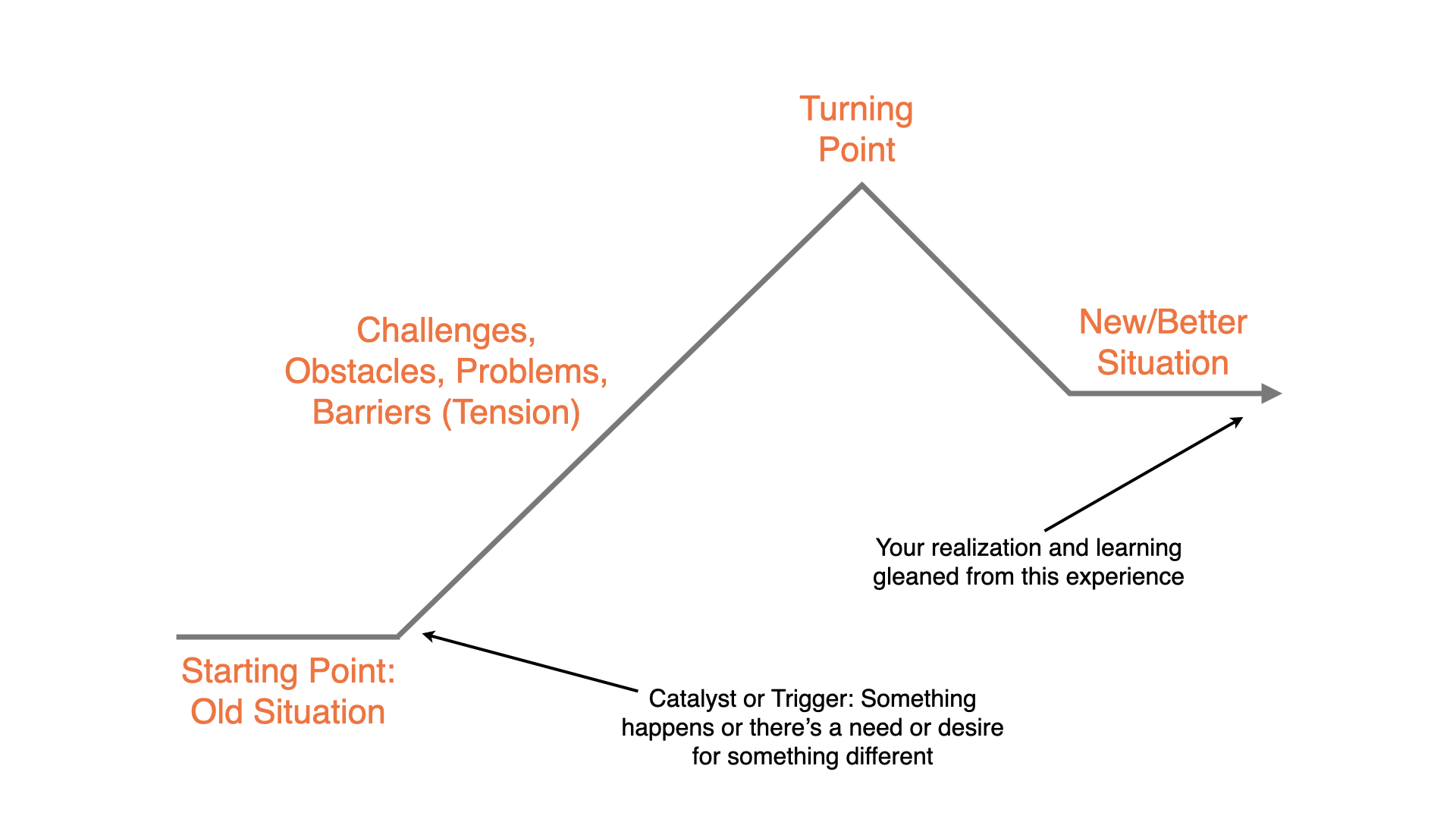
The diagram above shows the typical plot structure of a story (its framework, its arc) from start to finish. More specifically, the key landing points along this classic story arc include:
Starting Point — The time, the place in which the story begins; the platform that the characters start from; the old situation.
A Trigger or Catalyst — Something happens that sends the characters off on a new path, a different direction, or even a larger journey. This could be a goal, objective, or desire for something new; a change in circumstances; or something unexpected and unplanned forced upon the characters.
Challenges and Obstacles — Along this new path or larger journey, what were the problems and pitfalls the characters faced? What were the challenges or obstacles they experienced: not just physical, logistical, or operational challenges, but also (and very naturally) mental, emotional, and psychological ones? This key section of the plot is where tension is built.
Turning Point — That point when the tension gets resolved because the challenges were overcome, problems solved, or obstacles broken down. This turning point might be an epiphany, or change of attitude or perspective, but it could also be that moment when things just fell into place and started running smoothly.
New Situation and Learning from It — What life looks like after the turning point and how it’s somehow better than before (the “after” situation). Importantly, this part of the plot drives towards the wisdom, realization, or learning the storyteller gleaned from the experience: the point they’re making with the story.
If you’d like to review a good example of this classic story plot framework, read through this past blog post. Going even further, once you understand this basic plot structure, there are various ways you can evolve and refine it, including:
- Telling stories with no turning point or that don’t have a “happy ending.”
- Making your story plots tight and more focused
- Telling stories with data or about data.
Applying the Classic Plot to the Story of a Project or Initiative
Now that you understand the classic plot of a good story, applying it to the story of a project or initiative isn’t that difficult. What I often tell Business Storytelling Training workshop participants is simply take that basic plot structure outlined above and try to map out the history, the chronology of a project or initiative across it. More specifically:
What was the starting point of this project or initiative: the before situation for you, your colleagues, customers, or partners? This could also include some explanation of the situation you, your department, your company or clients were in.
What was that trigger or catalytic moment when you decided to take this initiative on (or were told to take it on), embarking on a journey with it? Relaying this trigger or catalytic moment should include the higher purpose driving your efforts, letting the audience know your intent with this initiative: your vision of the value it will bring when fully realized.
What happened along the way? What worked well and, just as importantly, what didn’t? What challenges and obstacles did you run into? As mentioned already, these could be more tangible obstacles like operational, financial, or logistical issues. But they should also include less tangible barriers, like uncertainty, apprehension, ambiguity, fear, etc. Don’t forget that stories involve human drama, even if that drama took place at work, conveying not just what happened, but also what was happening to you, your colleagues, and others. For example:
“And I have to tell you, honestly, that there was one week in mid-September where nothing seemed to be going right with this project. And we just kept looking at each other in the lab and wondering out loud, ‘Have we made a huge mistake? Are we on the right track with this thing?’ But we just kept pushing on, reminding ourselves how much we believe in the purpose of this initiative, but also acknowledging that trying something new is always unsettling and uncomfortable.”
What was the turning point when everything started to come together and work, when you started to see the fruits of your labours? For example:
“And then in the second week in October, it all started clicking. Everything just fell into place. The beta version was working as planned. The qualitative feedback from pilot participants was fantastic. The usage data coming in exceeded our expectations. And we not only breathed a huge sigh of relief, but also started seeing all this hard work paying off.”
What’s the new, better situation after the turning point? What’s the after state because of this project? What are you, your colleagues, customers, or other stakeholders now able to do and achieve because of this initiative?
What did you learn? What wisdom, realization or understanding did you take away from this whole experience? What’s the point of your story, the lesson, the core message you want your audience to take-away having heard it?
Keep in mind that some stories you tell about a project or initiative might not be complete. For example, if you’re doing a report-out to senior executives on the status of a project, and there’s no turning point yet, that’s ok. Or, if you’ve just gone through the turning point, you likely won’t yet know what the new, better situation looks like, and that’s also ok. But you can still tell a story up until that moment, finishing by letting your senior leaders know what the next steps are and what you anticipate the new, better state will be. In other words, it’s a story to be continued.
Add Two More Elements to Your Business Story
When someone just takes the history of an initiative and maps it out across the classic plot framework, they will instantly and easily transform what might have otherwise been a straight-forward report into more of a business story. To go even further and make the story of a project or initiative more strategic and relevant, I recommend wrapping that story with two additional components to what I outlined earlier: one at the start, the other at the end.
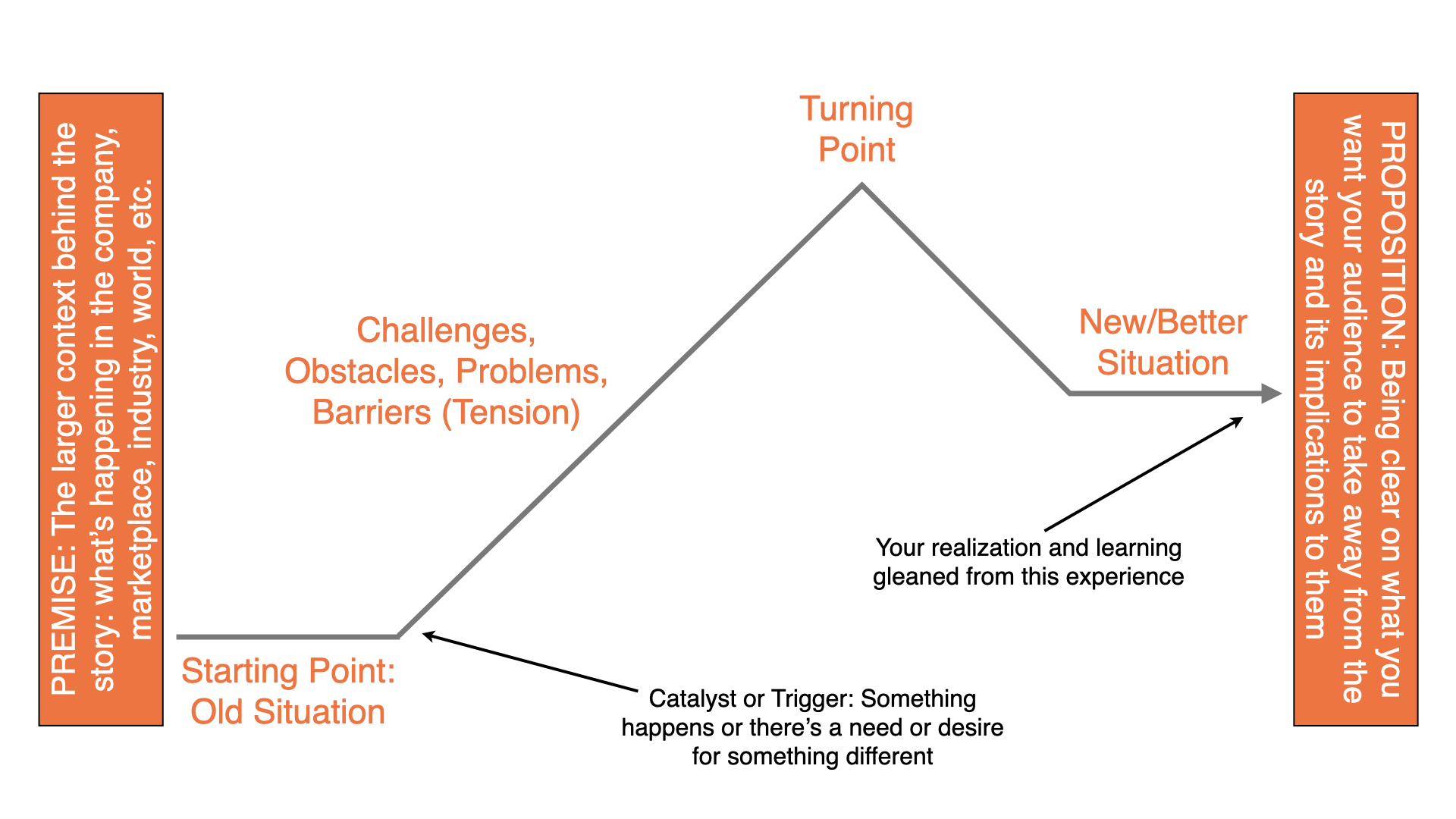
PREMISE — No initiative or project exists in a vacuum; nor does the story you tell about it. There is always some larger situation around it, a background (organizational, industrial, regional, global, etc.) against which that story takes place. So, before launching into the starting point of a project or initiative story, the storyteller should take some time to connect the story they are about to tell to the larger situation in which they’re telling it. This will give your initiative or project story more context, making it more relevant and strategic. For example:
“As you know, recent shifts in federal trade policies have had a major impact on our supply chain. We have had to completely rethink how, from where, and from whom we are ordering the supplies that go into our manufacturing, including revisiting and revising our relationships with long-term overseas suppliers while also being open to developing relationships with new ones. About three months into the enaction of these new trade policies, this is exactly what we decided to do, and Project Delta was born. More specifically, a group of us got together back in July…”
PROPOSITION — After making a clear point with the story you tell (articulating a key realization, what you learned or are learning because of this project, the wisdom you’re gleaning) you should consider going one step forward and proposing something to your audience. What are the implications for your audience specifically? What are you encouraging or inspiring them to do because of the story you’ve just shared? For example:
“While you can see we are very much on track—and everything we’re seeing, measuring, and hearing indicates it’s the right thing to be doing for our customers—the success we’ve had to date with this initiative is, in part, because of your endorsement of it. So, our hope is that you still see the value of this initiative and will continue to support it moving forward.”
Telling the story of an initiative or project isn’t as complicated or difficult as some might think once you understand the element of a good story and the fundamentals of effective business storytelling. Try putting this into practice for your next presentation, report-out to senior leaders, or meeting. Let me know if you have any questions, and good luck!
Bill Baker is the founder and principal of BB&Co Strategic Storytelling. For over 15 years, BB&Co has been providing Business Storytelling and Effective Presentation Skills training to organizations such as GE Healthcare, Bristol Myers Squibb, Dell, Johns Hopkins University Applied Physics Lab, Dell, Adobe, Oracle, and others.
